

Every week someone sends us a photo of a balcony and asks for a price to glass it in. The price is the easy part. The hard part is the question almost nobody asks first: does the outside of your flat actually belong to you? In most Dubai apartment buildings it does not, and that single fact decides whether your project is a two-day installation or a notice from building management telling you to take it down at your own expense.
- The short answer, before you call anyone
- What the law actually says
- The approval chain, in the order you need it
- Who your competent authority is
- Why most towers refuse a full enclosure
- Villas, townhouses and ground-floor terraces
- What you can do without touching the façade
- What happens if you do it anyway
- Your checklist before paying a deposit
- What to send a supplier so the quote is real
- The other emirates, briefly
- Where to start if you are not sure
- Questions we get asked
The short answer, before you call anyone
You can enclose a balcony in Dubai only if the people who control the outside of your building say yes in writing. For an apartment that normally means your owners association or building management, then your master developer, and then the authority that issues building permits for your area. For a villa on its own plot the chain is shorter but the permit still exists.
That is the whole answer. Everything below is about how to get those yes-es, how to tell early whether you are going to get them, and what you can install when the answer is no, because there is almost always something worth doing instead.
We should be straight about something that is unusual for a company that sells glass: a large share of the balcony enquiries we receive in apartment towers end with us recommending a different job. Not because the work is difficult, but because the approval is not going to come, and fitting it anyway would leave the customer with a bill to remove it. A supplier who quotes a balcony enclosure without ever mentioning an NOC is not doing you a favour.
What the law actually says
Most articles on this subject say vaguely that you need an NOC. It is worth knowing where that requirement comes from, because it changes how you argue your case.
Jointly owned property in Dubai is governed by Law No. (6) of 2019 Concerning Ownership of Jointly Owned Real Property in the Emirate of Dubai. Two parts of it matter to you.
The façade is not part of your unit
First, the outside of your flat is not yours. Article 7(a) lists what counts as the Common Parts of a building, and the structural elements of the property are on that list, including façades and roofs. Your balcony slab, the parapet, the elevation your balcony sits in: legally these sit in a different category from your living room. You own the unit. The envelope around it is shared.
Exterior changes need approval before they happen
Second, substantial exterior changes need approval before they happen. Article 39(a) provides that an occupant may make substantial alterations or modifications to the structure or external appearance of a unit, or to common property, only with the approval of the master developer, the Dubai Land Department and the competent authority, and construction legislation still applies on top of that. Note the word occupant: under the definitions in Article 2 that covers owners and tenants alike, so renting does not move you outside the rule.
Article 39(b) and (c) deal with what happens when the approval was never obtained. The occupant is liable to remedy the resulting damage at their own expense, in the manner the master developer or RERA prescribes, and if they do not, RERA or the master developer can appoint someone else to do it and charge the occupant for it.
One more detail that catches people out: Article 3 states the law applies to jointly owned property across the Emirate, including property in special development zones and free zones. Buying in a free zone community does not put you outside this framework.
The approval chain, in the order you need it
The order matters. Every step below asks to see the one before it, and going out of sequence is the most common reason a straightforward application takes four months.
- Your owners association or building management. Start here, always. They hold the building management regulation and the community rules, and they can tell you in one email whether enclosures have ever been approved in your tower. If the answer is a flat no, you have saved yourself everything that follows.
- The master developer. Emaar, Nakheel, Dubai Holding, Nshama, Damac and the rest each run their own fit-out and modification approval process through their community management arm. They are the ones protecting the look of the elevation across the whole community, so this is usually where a full enclosure succeeds or fails.
- A consultant or contractor who can produce drawings. Nothing moves without a drawing set. Depending on the scope you may need a structural statement about added load on the slab, and a note on how the new glazing line sits against the existing façade.
- The competent authority for your area. This is the body that issues building permits where your building sits. For most of Dubai that is Dubai Municipality. In some communities it is the zone regulator instead, which we cover in the next section.
- Any specialist approvals the scope triggers. If the work projects over a public right of way, Dubai Municipality’s own permit guidance directs applicants to the RTA service for balconies, building projections and terraces in the right of way. If the work involves external cladding on an existing project, the same guidance directs you to the Civil Defence department that handles external cladding approvals.
- Only then, order the glass. Lead times on made-to-measure aluminium systems are long enough that it is tempting to order early. Do not. A system sized to a drawing that later changes is a system you pay for twice.
Who your competent authority is, and why it is not always Dubai Municipality
Law No. (6) of 2019 defines the competent authority as the body in charge of issuing building permits and approving community plans in the Emirate. That phrasing is deliberately open, because Dubai does not have a single permit desk.
For most freehold and leasehold property in Dubai, Dubai Municipality is the permitting authority, and its Dubai Building Code sets the technical standards your drawings have to meet. Several communities sit under a different regulator: areas administered by the Ports, Customs and Free Zone Corporation are permitted through Trakhees, and parts of the city inside Dubai Development Authority zones go through DDA. Your building management will know which one applies to you, and it is the first thing worth asking them.
This is not a technicality. Submitting to the wrong authority does not get you a polite redirection; it gets you a rejected application and a restart.
| Step | Who you are asking | What you are asking for | Typical sticking point |
|---|---|---|---|
| 1 | Owners association / building management | Confirmation that enclosures are permitted in principle, and the community rules in writing | Many towers have a blanket policy already; getting it stated clearly saves months |
| 2 | Master developer community management | NOC for a change to the external appearance | Consistency of the elevation across the whole community |
| 3 | Consultant / contractor | Drawings, and a structural view on added load where relevant | Finding someone willing to stamp drawings for a single unit |
| 4 | Dubai Municipality, Trakhees or DDA | The permit for the modification | Submitting to the wrong authority for your zone |
| 5 | RTA, Civil Defence | Only where the scope triggers them, such as projection over a right of way or external cladding | Discovering the requirement after the main permit is in |
Why most apartment towers refuse a full enclosure
It helps to understand the refusal, because once you do you can often find the version of the project that does get approved.
A master developer is not protecting the view from your sofa. They are protecting four things:
The elevation
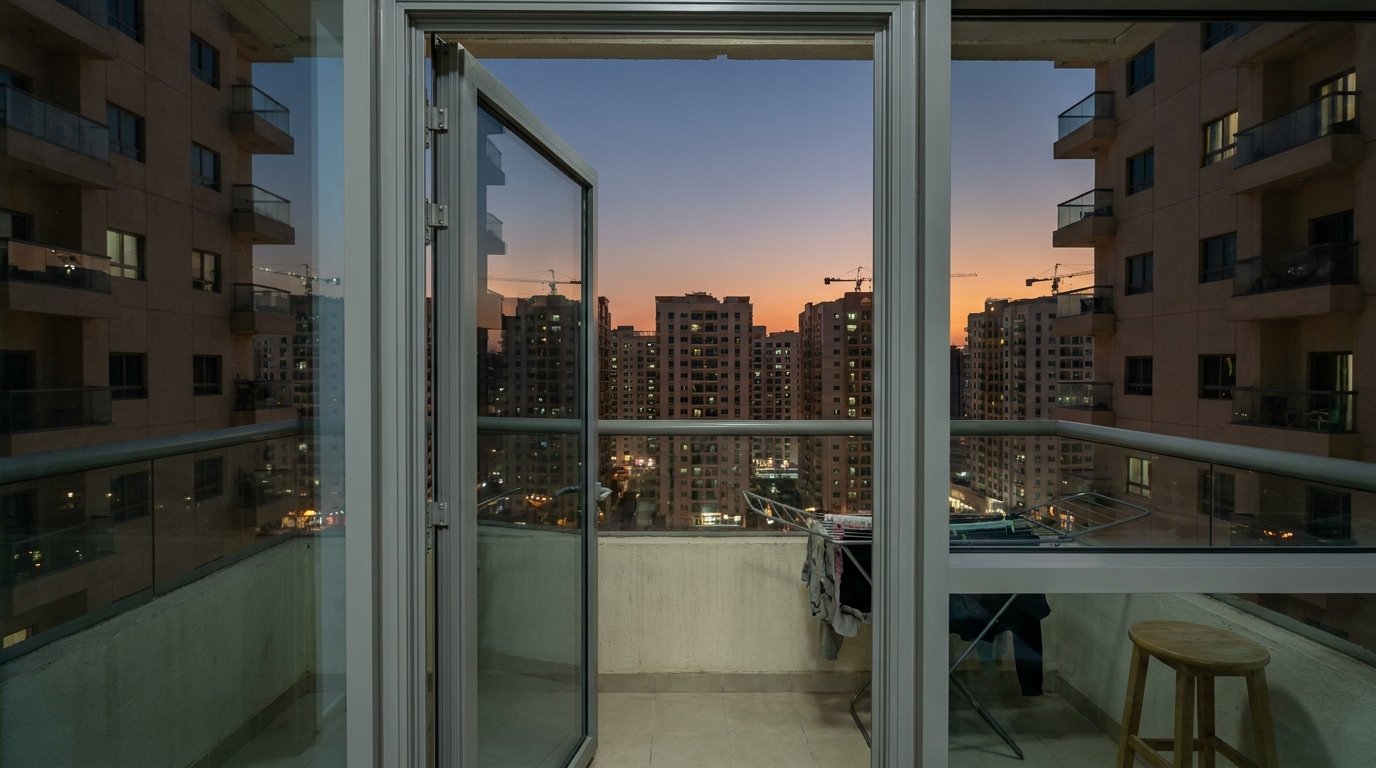
One enclosed balcony on a forty-floor tower is visible from the road. Approve one and the next ten applications are impossible to refuse, and the building ends up with a patchwork façade.
Added floor area
Enclosing a balcony can be treated as adding internal area to the unit, which touches the approved built-up area for the building rather than just your flat.
Load and fixing
New framing has to be fixed into a slab and a parapet that were designed for an open balcony and a handrail, not a glazed wall taking wind load.
Fire and access
Balconies play a role in how a façade behaves and how people get out. Changing the envelope of an existing building is treated carefully for a reason.
What this tells you about the applications that succeed
Read that list again and you can see the shape of the applications that do succeed. They are the ones where the elevation does not visibly change, no internal area is created, nothing new is fixed into the structure, and access is not affected. That is a narrow target, but it is not an empty one, and it is exactly where the next section lives.
Villas, townhouses and ground-floor terraces
A villa on its own plot is a different conversation, and this is where a surprising number of enquiries actually belong.
You still need a permit. Dubai Municipality’s published guidance for building permits points villa owners to the self-decoration route set out in Circular No. 231 of 2018 for decoration works, and to the Dubai Building Code for the setback and projection rules, which cover how far you can build towards your plot boundary. What you do not have is a neighbour whose window you are blocking or a shared elevation to match, so the objection that kills most apartment applications simply is not there.
In a gated community you will still need the community developer’s approval, because the master community declaration governs the look of the street. In our experience villa applications for enclosing a terrace or adding a glazed room succeed far more often than apartment applications, and they take about as long.
If the villa is new and you are still inside the developer’s defects period, deal with that first. Our handover snagging checklist for doors, windows and glass covers what the developer is still obliged to fix before you start paying for upgrades yourself.
What you can do without changing the façade
This is the part most articles skip, and it is the part that actually solves the problem for the majority of people who contact us.
Solve the actual complaint, not the imagined project
The complaint behind a balcony enclosure enquiry is almost never “I want a glass box”. It is “the balcony is unusable for eight months of the year”, or “sand gets everywhere”, or “the living room is hot because the balcony door is useless”. Those complaints have answers that do not alter the external appearance of the building at all, which means they do not engage Article 39 in the first place.
- Replace the existing balcony door like for like. Swapping a tired sliding door for a properly specified modern system in the same opening is maintenance, not a façade alteration. It is the single most effective thing you can do for heat and dust, and it is usually the cheapest. Our page on aluminium sliding doors in Dubai covers the frame and glass choices, and we wrote separately about what a balcony sliding door has to survive in Dubai heat and wind.
- Upgrade the glass, keep the frame line. If the opening and sightlines stay the same, moving from single glazing to a properly specified insulated unit changes how the room feels without changing how the building looks. The same logic applies to the aluminium windows either side of the balcony door, which are often the bigger heat gain.
- Fix the door you have. A large share of “my balcony is unusable” calls turn out to be worn carriages, a bent track or a failed brush seal. That is a repair, not a project. See window and door repair in Dubai.
- Shade rather than enclose. On a villa terrace or a large townhouse balcony, a louvred aluminium pergola gives you most of the usable months back and is a far easier approval than a glazed enclosure.
- Improve the internal line instead. Where the balcony genuinely cannot be touched, the gain is often indoors: a better folding door or a wider opening between the living room and the balcony changes how both spaces work.
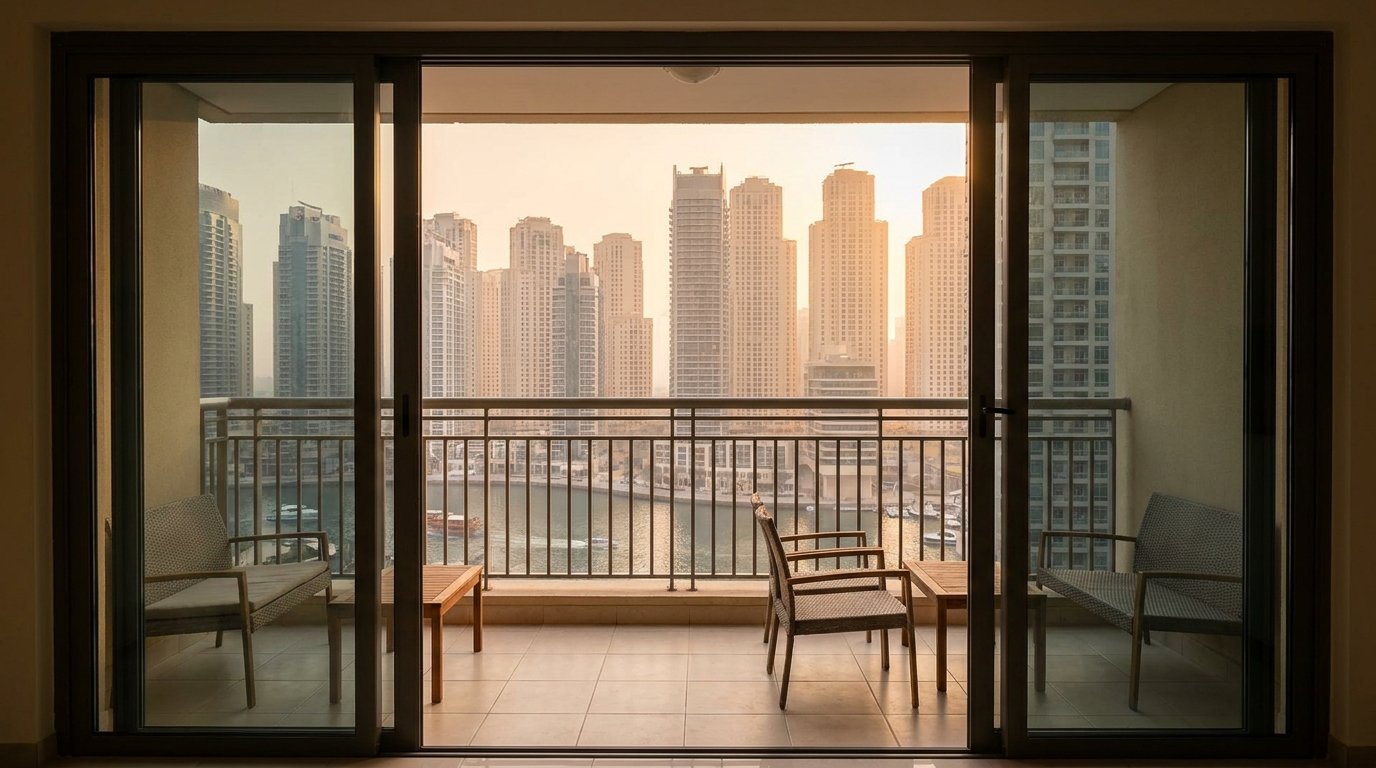
None of these need an NOC for a change to the external appearance, because none of them change the external appearance. That is not a loophole; it is the distinction the law draws.
What happens if you enclose without approval
People do it. Drive through some communities and you will see enclosures that plainly never went through a process. It is worth being clear about what the exposure is, because the risk is not the fine.
Under Article 39(b) of Law No. (6) of 2019 an occupant who makes substantial changes without the required approval is liable to remedy the resulting damage at their own expense. Article 39(c) adds that if they do not, RERA or the master developer can appoint another party to do the work and recover the cost from the occupant. In practice that means removal and reinstatement of the original condition, paid for by you, on someone else’s timetable.
The costs people underestimate
Beyond removal and reinstatement, the secondary costs matter:
- Resale. An unapproved structural change on a unit is something a buyer’s conveyancer can find, and it becomes a price negotiation at the worst possible moment.
- Insurance. An unapproved alteration to the building envelope is an awkward conversation after any incident involving that part of the property.
- Enforcement arriving years later. Communities periodically run compliance sweeps. Something that stood untouched for five years can still be served with a removal notice.
- The installer is gone. By the time the notice arrives, the company that fitted it frequently is not around to help.
Our own position is simple and we will not move on it: we do not fit a façade alteration without seeing the approval. It costs us work. It also means no customer of ours has ever been asked to tear one out.
Your checklist before paying any deposit
Work down this list in order. If you stall at any point, stop spending money until it is resolved.
- Get the community rule in writing. One email to building management: “Are balcony enclosures permitted in this building, and if so what is the approval process?” Keep the reply. This is the cheapest ten minutes in the whole project.
- Find out who your competent authority is. Dubai Municipality, Trakhees or DDA. Ask building management rather than guessing from the address.
- Establish whether the balcony is demised to your unit. Particularly for ground-floor terraces. Your title deed and the site plan settle it, not the sales brochure.
- Ask whether the enclosure adds built-up area. If it does, you are in a much heavier process than a glazing job and you should know that on day one.
- Only then get drawings. And get them before you get prices, because a quote without a drawing is a guess.
- Get the master developer NOC in writing. Not a phone call, not a “should be fine from our side”.
- Get the permit. In your name or your contractor’s, and know which.
- Now order the material. Not before.
What to send a supplier so the quote is real
Most balcony quotes are worthless because the enquiry did not contain enough to price. If you send the following, you will get numbers you can actually compare, and you will find out quickly who is serious.
| Send this | Why it changes the price |
|---|---|
| Building name, community and floor | Wind load on floor 38 is not wind load on floor 3, and the community decides the approval route |
| Photos of the full balcony, plus the parapet and the soffit above | What the system can be fixed into is the whole engineering question |
| Width and height of the opening, measured, not estimated | Panel count and glass thickness follow directly from the span |
| Whether you have an NOC yet, and from whom | A supplier who does not ask this is a supplier who will leave you exposed |
| What problem you are solving: heat, dust, noise, or space | The right answer is sometimes a different product entirely |
| Whether the existing door stays or goes | Changes the scope from glazing to a full opening rework |
If you want to see what finished work looks like at this level of detail, our project gallery has installations across Dubai and the Northern Emirates, and the aluminium and glass doors page covers the systems themselves.
The other emirates, briefly
This article is about Dubai, because the legislation we have cited is Dubai legislation. The principle travels, though: the municipality in each emirate permits building modifications, and if you are in a managed community the developer’s rules sit on top.
If you own in Abu Dhabi, Sharjah, Ajman, Ras Al Khaimah, Umm Al Quwain or Fujairah, the two questions are the same as in Dubai: who controls the external appearance of the building, and who issues permits for alterations in that emirate. Ask those two before you ask for a price. We install across all seven emirates, and the areas we cover page sets out where we work.
Where to start if you are not sure
If you are reading this because someone quoted you for a balcony enclosure and you now have doubts, the useful next step is not another quote. It is a fifteen minute conversation about which of the five approval steps above actually applies to your building, and whether the problem you are trying to solve needs an enclosure at all.
We survey across Dubai and all seven emirates, we will tell you plainly when an approval is not worth chasing, and we do not fit a fçade alteration without seeing the paperwork. If you would like us to look at your balcony, send us the details and photos here and we will come back with either a scope or an honest reason not to proceed.
Questions we get asked
Can I enclose my balcony in Dubai?
Only with approval. Under Law No. (6) of 2019 the façade of a building is part of the Common Parts under Article 7(a), and Article 39(a) requires the approval of the master developer, the Dubai Land Department and the competent authority before an occupant makes substantial alterations to the structure or external appearance of a unit. In practice you start with your owners association or building management, then the master developer, then the permitting authority for your area. Many apartment towers have a standing policy against enclosures, so the first email is the one that matters.
Do I need an NOC to close my balcony with glass?
Yes, if the work changes the external appearance of the building, which a glazed enclosure does. The NOC from your master developer or community management is normally the document that unlocks everything else, and the permitting authority will expect to see it. A supplier who offers to install without one is transferring the entire risk to you.
Who approves a balcony enclosure in Dubai?
Typically three parties in sequence: your owners association or building management, your master developer’s community management team, and then the competent authority that issues building permits for your area. Law No. (6) of 2019 defines the competent authority as the body in charge of issuing building permits and approving community plans in the Emirate. For most of Dubai that is Dubai Municipality; in some communities it is Trakhees or the Dubai Development Authority instead.
What happens if I enclose my balcony without permission?
Article 39(b) of Law No. (6) of 2019 makes the occupant liable to remedy the resulting damage at their own expense, in the manner prescribed by the master developer or RERA. Article 39(c) allows RERA or the master developer to appoint another party to carry out the work and recover the cost from the occupant. In practice that means removal and reinstatement, paid for by you. There are knock-on effects at resale and on insurance as well.
Does the rule apply if I am renting?
Yes. Article 39 applies to the occupant, and the definitions in Article 2 of the law describe an occupant as any person using a unit for its intended purposes, which covers tenants as well as owners. A tenant would also need the landlord’s consent in addition to everything else.
Is it easier to enclose a terrace on a villa?
Usually, yes. A villa on its own plot does not have a shared elevation to match or a neighbour’s view to protect, which removes the objection that defeats most apartment applications. You still need a permit, and the Dubai Building Code setback and projection rules still apply, and in a gated community the developer’s approval is still required.
Can I replace my balcony sliding door without approval?
Replacing a door in the same opening, in the same frame line and the same finish, is normally treated as maintenance rather than a change to the external appearance, so it does not engage the same approval requirement. The qualifier matters: if the replacement changes the visible frame colour, the glass tint or the sightline, some buildings will treat it as a change in appearance. Ask building management, keep the reply in writing, and you are covered either way.
Does a balcony enclosure count as added built-up area?
It can, and this is the question worth asking early. Converting open balcony space into enclosed internal space can be treated as adding floor area to the unit, which engages the approved built-up area for the building rather than only your flat. If the answer from your developer is yes, the application is a significantly heavier process than a glazing job and you should know that before you spend anything.
Do free zone and special development zone communities follow the same rules?
Article 3 of Law No. (6) of 2019 states that the law applies to master projects and jointly owned real property in the Emirate, including those in special development zones and free zones. What changes in some of those communities is which authority issues the permit, not whether approval is needed.
Written by the installation team at Solo Dream, who survey, supply and fit aluminium doors, windows and glass across the UAE. Legal references are to Law No. (6) of 2019 Concerning Ownership of Jointly Owned Real Property in the Emirate of Dubai on the Dubai Legislation portal. Technical standards and permit routes are set out in the Dubai Building Code and in Dubai Municipality’s FAQ for Buildings Permit Procedures and Regulations. This article is practical guidance from a contractor, not legal advice. Community rules differ between buildings, so confirm your own position with your building management before committing to any work.