

A sliding door stops locking. A window handle snaps. The shower screen starts leaking onto the bathroom floor. In a rented home in Dubai the first question is never how to fix it, it is who is paying for it. Most of the answers online quote a five hundred dirham rule that does not appear anywhere in Dubai’s tenancy law. This is what the law actually says, what your contract can and cannot change, and how the fault itself usually decides the argument.
- The short answer
- What the law actually says
- The AED 500 rule that is not a rule
- Fault by fault: who normally pays
- Wear and tear or misuse: how a technician tells
- The three arguments unique to the UAE
- What your contract can and cannot change
- How to document a fault so it gets paid for
- Security deposits and end-of-tenancy claims
- If you cannot agree
- For landlords and property managers
- Where we fit in
- Questions we get asked
The short answer
In Dubai the starting position is that the landlord pays. Article 16 of Law No. (26) of 2007 makes the landlord responsible for maintenance works during the lease and for repairing any defect or damage that affects the tenant’s intended use of the property, unless the parties have agreed otherwise. Article 17 adds that the landlord is responsible for defects, damage, deficiencies and wear and tear that the tenant did not cause.
Two words in that paragraph do all the work. Unless means your tenancy contract can move the obligation, and in Dubai most contracts do, at least partly. Cause means that once a contract clause runs out, the argument becomes a factual one about what broke the door, not a legal one.
So the honest answer is a sequence rather than a single rule:
- Read the maintenance clause in your tenancy contract. It overrides the default. If it is silent, the landlord carries it.
- Ask what caused the fault. Fair wear, a manufacturing defect or an installation fault sits with the landlord. Damage from misuse or neglect sits with the tenant.
- Only then talk about money. The cost of the job does not decide who owes it, whatever the contract’s dirham figure suggests.
What the law actually says
Dubai’s landlord and tenant relationship is governed by Law No. (26) of 2007 Regulating the Relationship between Landlords and Tenants in the Emirate of Dubai, issued on 26 November 2007 and later amended by Law No. (33) of 2008. Six articles decide almost every door and window argument.
The landlord’s side
- Article 15 — handover condition. The landlord must hand over the property in a condition that allows the tenant the full use agreed in the contract. A door that did not lock on day one was never the tenant’s problem.
- Article 16 — maintenance during the lease. Unless the parties agree otherwise, the landlord is responsible for the property’s maintenance works during the lease, and for repairing any defect or damage that affects the tenant’s intended use.
- Article 17 — defects and wear. The landlord is responsible for defects, damage, deficiency and wear and tear that are not the tenant’s fault. The same article stops the landlord making changes that prevent the tenant using the property properly.
- Article 18 — approvals for tenant works. Where a tenant wants to carry out decoration or similar works that need official approval, and the works do not affect the structure of the building, the landlord must provide the approvals needed.
The tenant’s side
- Article 19 — the standard of care. The tenant must pay rent on time and look after the property with the care an ordinary person would give their own property. The tenant may not carry out alterations, restoration or maintenance without the landlord’s permission and the required licences, except for restorations that were agreed or are customary for tenants.
- Article 20 — the deposit. The landlord may take a security deposit at the start of the lease to ensure the property’s upkeep at the end of it, and must return the deposit or what is left of it when the lease expires.
- Article 21 — handing it back. On expiry the tenant must return the property in the condition it was received in, apart from ordinary wear and tear and damage outside the tenant’s control.
Read those together and the shape is clear. The landlord owns the condition of the building and everything in it that simply ages. The tenant owns their own behaviour. A door that wore out is the landlord’s. A door that was forced is the tenant’s. Everything contested sits in the gap between those two sentences, which is what the rest of this article is about.
The AED 500 rule that is not a rule
Search this question and you will be told, confidently and repeatedly, that repairs under AED 500 are the tenant’s and anything above is the landlord’s. Some articles use AED 1,000. They are presented as if they came from the legislation.
They did not. There is no monetary threshold anywhere in Law No. (26) of 2007. Not in Article 16, not in Article 17, not anywhere else. The Dubai Land Department’s own tenancy guide sets out the same articles and contains no such figure either.
What is true is that a very large number of Dubai tenancy contracts contain a clause along the lines of “the tenant shall bear minor maintenance up to AED 500 per incident”. That clause is enforceable because Article 16 lets the parties agree otherwise. It is a term of your contract, not a provision of the law, and that distinction matters in three practical ways:
- If your contract has no such clause, the figure does not apply to you. The default in Article 16 does.
- The figure in your contract is the one that counts. We have seen AED 300, AED 500, AED 1,000 and “first repair of each year”. Do not argue from somebody else’s number.
- A cost cap does not transfer a landlord obligation. A clause making the tenant pay small sums for ordinary upkeep is not the same as making the tenant liable for a structural defect that happens to be cheap to fix, or for a failure the landlord was already asked to repair and did not.
Fault by fault: who normally pays
This is the table we wish every tenant and landlord had in front of them before the first message. It reflects how these cases are usually resolved in practice under Articles 16, 17 and 19, assuming an ordinary contract with a small-sums clause. Your own contract can change the outcome.
| The fault | What has usually failed | Who normally pays | Why |
|---|---|---|---|
| Sliding door has come off its track or jumped | Worn carriages, a bent track, or a panel that was never adjusted | Landlord | A panel does not leave its track from ordinary use. This is wear or an installation fault under Article 17 |
| Sliding door drags and needs a shoulder | Collapsed roller bearings, often with sand packed into the track | Landlord, cleaning aside | Bearings are a consumable with a service life. Keeping the track clear is reasonably the tenant’s |
| Door will not lock or the latch misses the keep | Panel has dropped, or the keep has moved | Landlord | Security of the property goes to the tenant’s intended use under Article 16 |
| Handle has snapped off in the hand | Fatigue in a die-cast handle, or forcing | Depends on how | A handle that failed under normal pressure is wear. One snapped while forcing a jammed panel follows the jam, not the handle |
| Glass cracked with no impact mark | Spontaneous breakage or an edge nip from installation | Landlord | No tenant act caused it, so Article 17 applies |
| Glass cracked with a clear impact point | Something struck it | Tenant | Outside the ordinary care standard in Article 19 |
| Double-glazed unit has gone cloudy inside | Failed edge seal in the sealed unit | Landlord | A manufacturing failure. A tenant cannot cause it from inside the room |
| Shower screen leaking onto the floor | Perished seal strip, failed silicone line, or a door dropped on its hinges | Landlord | Seals perish on a timetable of their own. Replacing them is upkeep |
| Window will not close fully in summer only | Thermal movement plus a frame that was tight from the start | Landlord | A tolerance problem in the installation, not something the tenant introduced |
| Brush seals shedding, draught and dust coming in | Pile seals worn flat | Landlord | A wearing part replaced as part of maintenance |
| Track full of sand and the door is stiff | Nothing has failed yet | Tenant | Routine cleaning is ordinary care under Article 19 |
| Hinges stained and seized after a year with no cleaning | Corrosion from neglect, common near the coast | Tenant, usually | Neglect of simple upkeep falls short of the Article 19 standard |
| Mosquito screen torn | Mesh damage | Tenant, usually | Low-cost consumable and almost always captured by a small-sums clause |
| Door damaged by a contractor the tenant hired | Anything | Tenant | The tenant is answerable for people they bring in |
| Fault reported and ignored, then it got worse | A small repair that became a large one | Landlord, for the escalation | The additional damage flows from the failure to repair, not from the tenant |
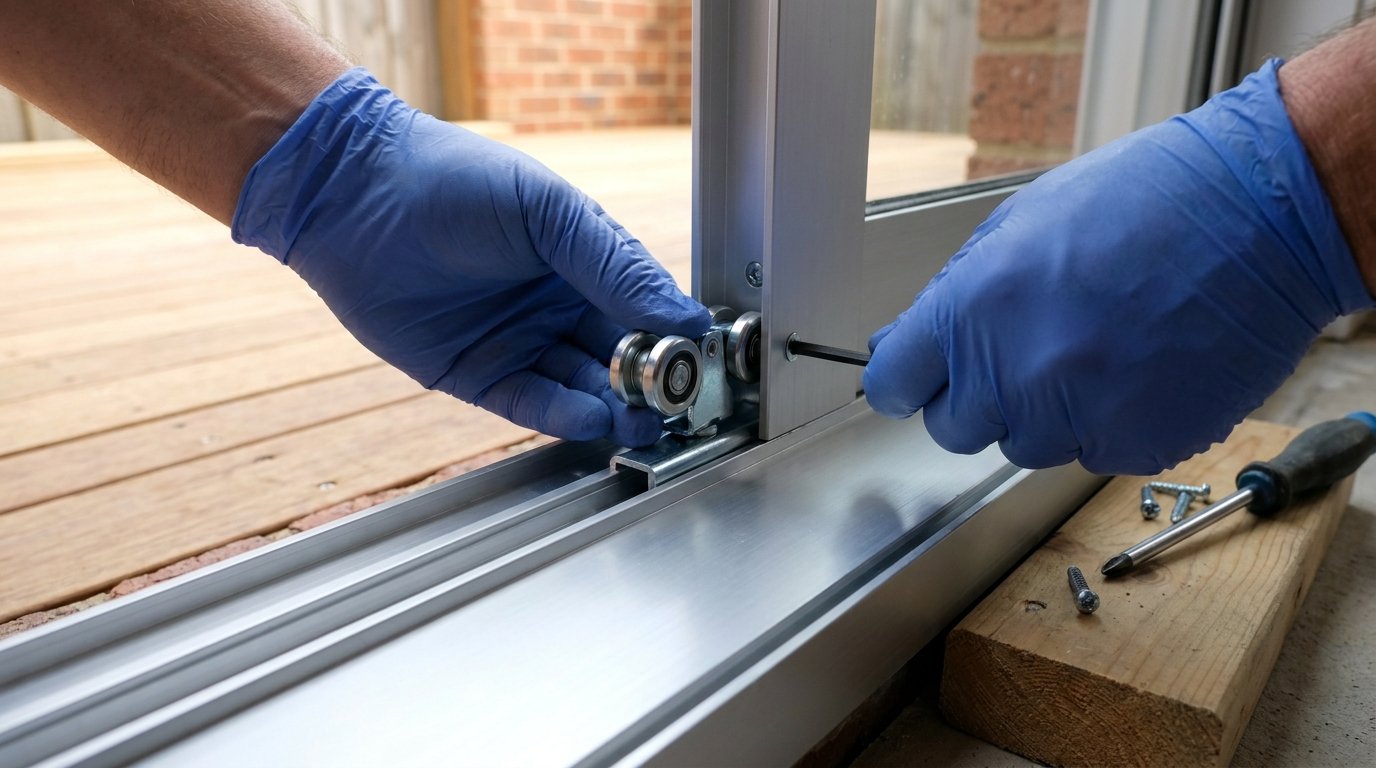
The pattern across that table is worth saying plainly. Almost everything that fails on an aluminium door or window in Dubai fails because a part reached the end of its life, not because somebody mistreated it. Carriages, seals, gaskets, hinges and sealed units are consumables. That is why the default in Article 16 sits where it does.
If you want the detail on what actually goes wrong with these systems and what a proper repair involves, our page on window and door repair in Dubai covers the common faults by type.
Wear and tear or misuse: how a technician tells
This is the part no legal article can give you, and it is usually what settles the argument. When we open up a failed door, the cause is written on the parts.
Even wear on both carriages
Both sides worn to a similar degree means time and load did it. A single destroyed carriage with the other one clean usually means an impact or a forced panel.
Polished track, no gouges
A smooth, bright wear band is normal service. Gouges and burrs mean the panel ran off its wheels, which is itself a fault, not a misuse.
Seal material crumbling along its length
Uniform perishing is age and UV. A seal torn in one place is a mechanical event.
Crack origin in the glass
Glass tells you where it started. An edge origin points to installation stress or a nipped edge. A point origin on the face points to an impact.
Corrosion pattern on hardware
Even surface dulling across all hardware is a coastal-air and cleaning story. One seized hinge among four clean ones is something else.
Screws and witness marks
Fresh tool marks on screw heads mean somebody has already been at it. That matters, because a previous bad repair is not the tenant’s liability unless the tenant arranged it.
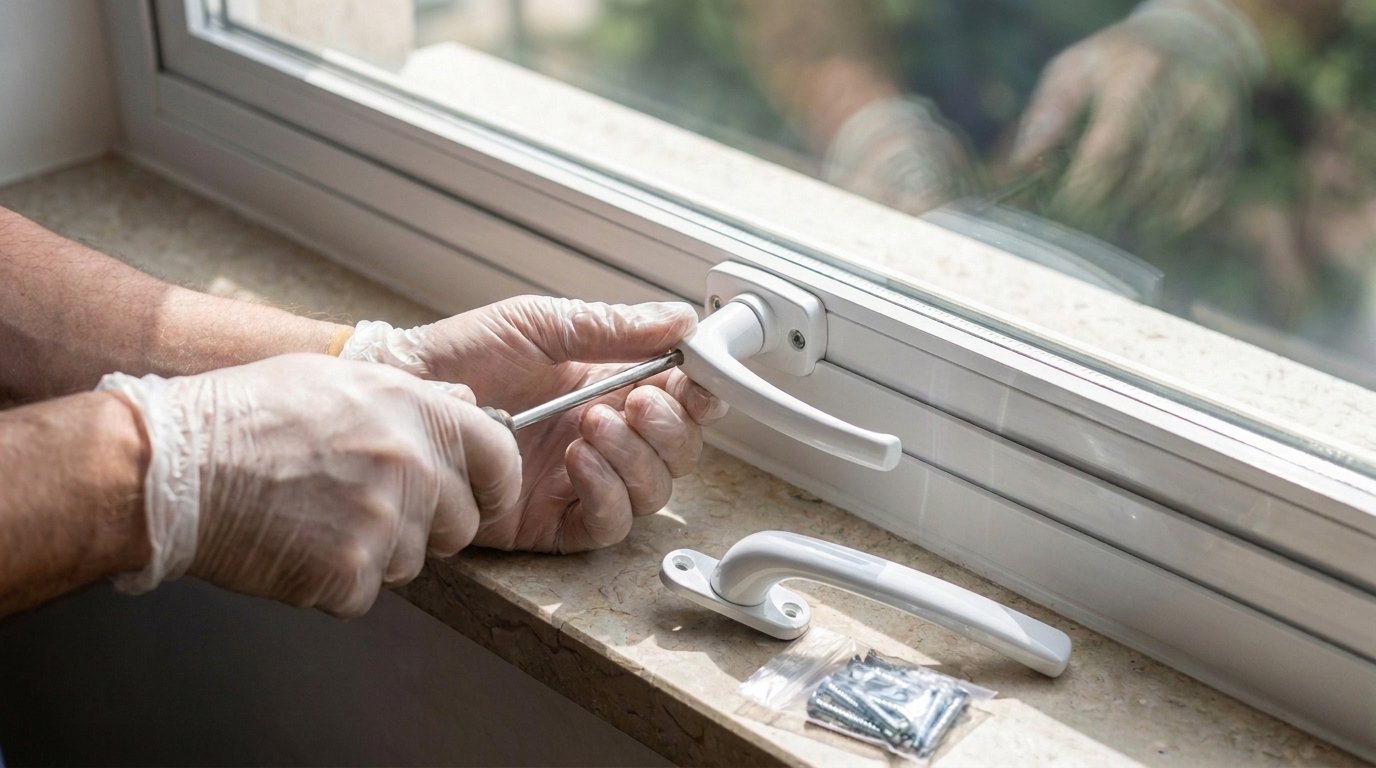
None of this is exotic. It is the ordinary diagnosis any competent technician does before quoting. The reason it matters here is that a written report naming the failed part and the cause turns a stand-off into a decision. We will come back to that under documenting a fault.
The three arguments unique to the UAE
Dubai produces three recurring disputes that you would rarely see in a cooler, drier market. Knowing where each one usually lands saves a lot of time.
Sand in the tracks
Fine sand gets into every sliding track in this city. The split that holds up in practice: keeping the track clear is ordinary care and sits with the tenant, but the damage sand causes to bearings over years is wear and sits with the landlord. A tenant who never cleaned a track for three years has weakened their position. A tenant who cleaned it and still had carriages fail has not.
Heat movement
Aluminium expands. A system installed with tight tolerances will bind in August and behave in February. A door that only misbehaves in summer is almost always an installation or specification problem, not a tenant problem. Our write-up on what a balcony sliding door has to survive in Dubai heat and wind explains why this happens.
Coastal corrosion
In Marina, JBR, Palm and along the coast generally, salt air attacks hardware far faster than inland. Hardware specified without adequate coating for that exposure is a specification failure, which is the landlord’s. Hardware that was never once wiped in four years is closer to neglect. Most real cases sit somewhere between, which is why the condition of the other hardware in the same property is usually the deciding evidence.
What your contract can and cannot change
Article 16 opens with “unless the parties agree otherwise”, so the contract is where you look first. In practice clauses fall into four shapes.
| Clause you may have | What it does | What it does not do |
|---|---|---|
| No maintenance clause at all | Leaves the Article 16 default in place: landlord maintains and repairs | Nothing. This is the cleanest position for a tenant |
| “Tenant bears minor maintenance up to AED X per incident” | Moves small repairs to the tenant up to that figure | Does not make the tenant liable for a structural or specification defect, and does not stack across one job split into parts |
| “Tenant responsible for all internal maintenance” | Broad transfer of day-to-day upkeep inside the unit | Rarely reaches the building envelope. External windows, the façade glazing line and the balcony door frame are not usually “internal” |
| “Tenant to hold an annual maintenance contract” | Obliges the tenant to arrange servicing | Does not convert a failed component into the tenant’s fault, and does not cover replacement of defective parts |
Two more points worth knowing. First, a clause cannot sensibly make a tenant responsible for a fault that existed before they moved in, because Article 15 puts handover condition on the landlord. Second, Article 19 bars the tenant from carrying out restoration or maintenance without the landlord’s permission, so a tenant who goes ahead and has a door rebuilt unilaterally can find themselves arguing about the work as well as the bill. Ask in writing, then act.
How to document a fault so it gets paid for
Most of these disagreements are not really disagreements about law. They are disagreements about facts that nobody recorded. Five minutes of evidence at the right moment settles them.
- Report it in writing the day you notice it. WhatsApp to the agent is fine, email is better. Describe the behaviour, not your theory: “the balcony door needs both hands and will not latch”, not “the rollers are broken”.
- Take a ten second video. Open and close the door at normal speed, in one take, with the handle and the floor in shot. This single piece of evidence is worth more than any description.
- Photograph the part, not the room. The track, the carriage, the crack origin, the perished seal. Close, in focus, with something for scale.
- Keep the reporting date visible. If the fault worsens while the landlord considers it, the date of first report is what separates the original repair from the escalation.
- Get a technician’s report naming the failed part and the probable cause. One page is enough. “Both bottom carriages collapsed, bearing cages disintegrated, track polished with no impact damage, consistent with end of service life” ends the conversation that “the door is broken” never will.
- Do not have unilateral work done while it is in dispute unless it is urgent for safety or security, and if you must, document why and tell the landlord first.
Security deposits and end-of-tenancy claims
The deposit is where most door and glass arguments actually surface, because they surface at the end when nobody is motivated to be generous.
Article 20 allows the landlord to take a deposit to ensure upkeep of the property at the end of the lease, and requires the deposit or its balance to be returned when the lease expires. Article 21 requires the tenant to hand the property back in the condition it was received, except for ordinary wear and tear and damage outside the tenant’s control.
Those two articles together are the whole test. A deduction is defensible when it covers damage the tenant caused. It is not defensible when it covers a component that simply reached the end of its life during a three-year tenancy.
- Sliding door carriages replaced after four years of tenancy. Hard to defend as a deduction. They are a wearing part.
- A cracked glass panel with an impact point. Defensible.
- Perished shower screen seals. Hard to defend. Seals perish on their own schedule.
- A door with gouged tracks after the panel ran off and nobody reported it. Contested, and usually turns on whether the tenant reported the original fault.
- Re-anodising or repainting frames as “making good”. Not usually a tenant cost at all.
The practical defence on both sides is identical and dull: a dated photographic record at move-in and move-out. Tenants who have one rarely lose a door argument. Landlords who have one rarely lose a damage claim.
If you cannot agree
Rent disputes in Dubai are heard by the Rent Disputes Settlement Centre, established under Decree No. (26) of 2013, which has exclusive jurisdiction over rent disputes between landlords and tenants of property in the Emirate, including in free zones. It replaced the earlier Special Tribunal. The Centre sits under the Dubai Land Department, and publishes its filing process on its own site.
Worth saying clearly: for a single door repair, the Centre is rarely proportionate. Filing costs money and time, and the sums in dispute are usually smaller than the effort. The Centre matters in two situations. One, a repeated or safety-related failure the landlord will not address, such as an entrance door that will not lock. Two, a deposit deduction large enough to be worth contesting.
In both cases the evidence that decides it is the evidence described above, gathered months earlier. That is the real reason to document a door fault properly on day one.
For landlords and property managers
If you own or manage units, the economics run the other way from the instinct to delay.
- A carriage is cheap, a track is not. Running a sliding door on failed bearings grinds the track. Replacing a track means removing the panels and often the frame. The repair you postponed for a few hundred dirhams routinely becomes a few thousand.
- Security faults are not deferrable. A door or window that will not lock touches the tenant’s intended use of the property directly under Article 16, and it is the category most likely to end up in front of the Centre.
- Specify for the exposure, once. Coastal units eat hardware. Fitting coated hardware suited to the location costs a little more and removes a recurring dispute. The same applies to glass specification on a hot elevation, which we cover on our aluminium windows and sliding doors pages.
- Keep a dated condition record per unit. Photographs of every door, window and glass panel at handover. It ends deposit arguments in one message.
- Service the whole building at once. Carriages, seals and hinges across a block are cheaper serviced together than attended one emergency at a time, and the faults arrive in waves because the units were fitted in the same month.
Where we fit in
We are a doors, windows and glass contractor, not a party to anybody’s tenancy. What we can do is remove the factual uncertainty that keeps these arguments going.
If you are a tenant, we can attend, diagnose the fault and give you a written report that names the failed component and the probable cause, which you can forward to your landlord or agent. If you are a landlord or managing agent, we can do the same before you approve a cost, and carry out the repair properly once the question is settled. We work across Dubai and all seven emirates, on aluminium and glass doors, folding systems and shower screens, and you can see the standard of work in our project gallery.
If you want someone to look at a door before the argument hardens, send us the details and a short video here.
Questions we get asked
Who pays for door and window repairs in a Dubai rental?
By default the landlord. Article 16 of Law No. (26) of 2007 makes the landlord responsible for maintenance works during the lease and for repairing defects or damage affecting the tenant’s intended use, unless the parties agree otherwise. Article 17 adds defects and wear and tear not caused by the tenant. Your tenancy contract can shift small repairs to you, so read the maintenance clause first, then ask what caused the fault.
Is the AED 500 maintenance rule part of Dubai law?
No. There is no monetary threshold anywhere in Law No. (26) of 2007, and none in the Dubai Land Department’s tenancy guide. The figure comes from a clause that appears in many Dubai tenancy contracts, and the amount varies between contracts. If your contract contains no such clause, the figure does not apply to you and the Article 16 default stands.
My sliding door has come off its track. Is that my fault as a tenant?
Normally no. A panel does not leave its track through ordinary use. It happens when carriages collapse, when a track is bent or when the panel was never properly adjusted, all of which fall under the defects and wear and tear the landlord is responsible for under Article 17. The main thing that weakens a tenant’s position here is not reporting it, because a panel left running off its wheels damages the track, and that escalation becomes contestable.
Who pays if the shower screen starts leaking?
Usually the landlord. A leaking shower screen is nearly always a perished seal strip, a failed silicone line or a door that has dropped on its hinges, and all three are wearing components rather than damage caused by the tenant. The exception is physical damage to the glass or hardware, which follows the usual fault test.
Can my landlord take door or window repairs out of my security deposit?
Only for damage you caused. Article 20 lets the landlord hold a deposit to ensure upkeep at the end of the lease and requires its return, and Article 21 requires you to return the property in the condition you received it apart from ordinary wear and tear and damage outside your control. Replacing a worn carriage or a perished seal after a multi-year tenancy is wear, not damage, and is hard to defend as a deduction. A cracked panel with a clear impact point is a different matter.
The handle snapped in my hand. Who pays?
It depends on what the handle was doing at the time. Die-cast handles fatigue and fail under normal pressure, which is wear. A handle that broke while forcing a panel that was already jamming follows the jam rather than the handle, and the jam is usually the landlord’s. This is exactly the situation where a technician’s report on the state of the rest of the mechanism decides it.
I reported a fault months ago and nothing happened. Where do I stand?
Your position is stronger, not weaker, provided you reported it in writing and kept the date. Article 16 places the repair duty on the landlord, and damage that develops because a reported fault was left unrepaired flows from the failure to repair rather than from you. Keep the original message, keep a dated video, and send a short written reminder rather than letting it go quiet.
Can I just get the door fixed myself and deduct it from the rent?
Be careful. Article 19 prevents a tenant carrying out restoration or maintenance works without the landlord’s permission and the required licences, except for restorations that were agreed or are customary for tenants. Deducting from rent unilaterally is a separate risk again. Ask in writing, give a reasonable deadline, and keep the correspondence. If the fault is urgent for safety or security, document why before acting.
Who hears the dispute if we cannot agree?
The Rent Disputes Settlement Centre, established under Decree No. (26) of 2013, which has exclusive jurisdiction over rent disputes between landlords and tenants of property in the Emirate, including free zones. It replaced the earlier Special Tribunal. For a single small repair it is rarely proportionate; it matters for a repeated or safety-related failure, or for a deposit deduction worth contesting.
Written by the repair team at Solo Dream, who diagnose and fix aluminium doors, windows and glass in rented and owner-occupied homes across the UAE. Legal references are summarised from Law No. (26) of 2007 Regulating the Relationship between Landlords and Tenants in the Emirate of Dubai on the Dubai Legislation portal, as amended by Law No. (33) of 2008, and from the Dubai Land Department’s tenancy guide. Disputes are heard by the Rent Disputes Settlement Centre under Decree No. (26) of 2013. The Arabic text of any legislation prevails. This article is practical guidance from a contractor and is not legal advice; for a live dispute, take advice on your own tenancy contract.